.                                o    r    n    a    +    m    e    n    t    a    l          d    e    s    i    g    n

9.23.2009


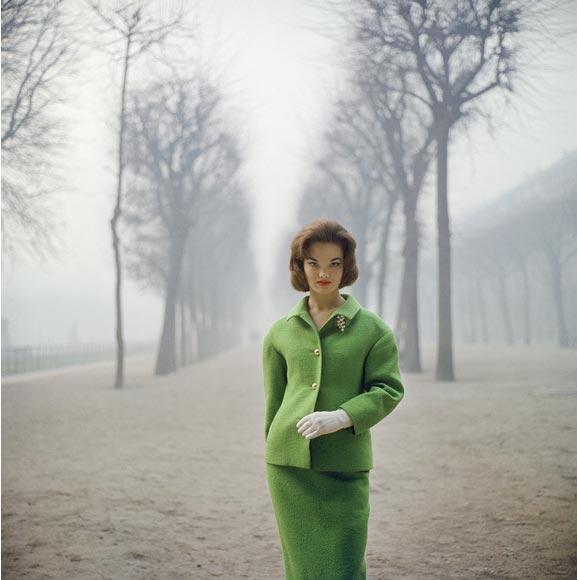
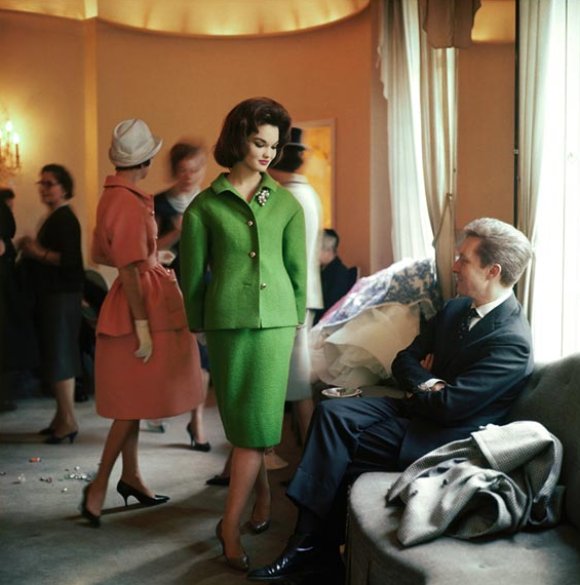
Mark Shaw captured these images of Henrietta Tiarks (who would later become the Duchess of Bedford) at Palais Royale in Paris in 1959. The photos are outtakes from a fashion assignment for LIFE magazine and were never intended for publication. The Duchess is modeling a green Jules-François Crahay suit. That's Monsieur Crahay himself (below) ogling his creation at the Nina Ricci salon.


Prints of these images are available, along with a host of other Mark Shaw photographs, at the Mark Shaw Photographic Archive.


:mark shaw; other images of the duchess of bedford at the national portrait gallery

11.12.2008


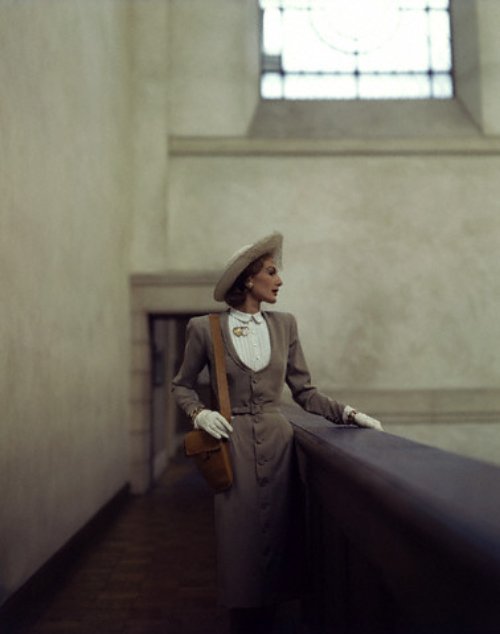
John Rawlings (1912-1970) was one of the most prolific photographers of the 20th Century, with more than 200 Vogue and Glamour covers to his credit, as well as numerous ad campaigns and nude studies.

Rawlings’s three-decade affiliation with Conde Nast began in 1936, when he was hired by Vogue Studios as an apprenticed assistant working alongside many legendary masters, including Cecil Beaton, Horst P. Horst, George Hoyningen-Huene, Irving Penn and George Platt Lynes.


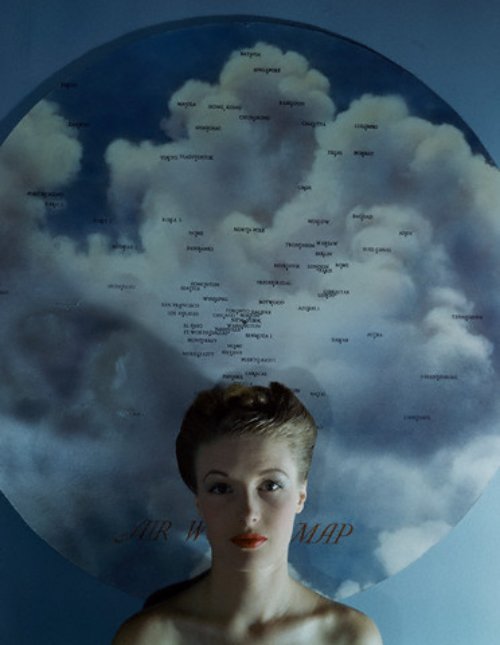
Memo headline: Women in Necessary Civilian Jobs


Although his early work for British Vogue showed the strong influence of Hoyningen-Huene and Horst, Rawlings slowly departed from their style. "Rawlings was certainly the first major Conde Nast photographer to demonstrate a truly American eye ... John Rawlings's photography has a practical, no nonsense feeling ... he focused his lens on the vibrant world surrounding him," writes Charles Dare Scheips Jr., former director of the Conde Nast Archives, in his introduction to Kohle Yohannan's book, John Rawlings: 30 Years in Vogue. "Rawlings brought a realistic visual style, presenting fashion as a force rather than a decoration."


:john rawlings via foto decadent

9.15.2008

visionaries: tim walker


Tim Walker's evocative images are full of textured nuance and intriguing detail. Stunning sets and lavish locations juxtapose the everyday with the absurd and the fabulous, to create captivating, original photographs.


Walker loves turning "funny daydreams into funny photographs," adding that he lives much of the time in an imaginary world, a world rooted in real-life and memory, specifically the British countryside of his childhood.


How does he pull off such elaborate productions? According to Andrew Thomas, one of Walker's agents:

Every season there comes a conversation with Tim on his ideas for upcoming stories. Tim is going to suspend a model on a giant hook; float a bathroom in the sea; paint various animals in pastel shades; attach a bed to the top of a classic car and then drive it; a roomful of rabbits; a tree in a house; a horse in a house. Then it dawns on you: how on earth is all of this going to be accomplished? Eventually, somehow, it all comes to fruition.


Walker's work is on exhibit at The Design Museum through September 28. Has anyone out there been lucky enough to see it?

Anyone?


:tim walker; daily telegraph; images © tim walker pictures


This Tim Walker shot of Sacha Pivovarova in Kizhi, Russia, appeared in a 2006 issue of British Vogue. One of Walker's assistants, Michelle Duguid, was there for the shoot. She recounts this lovely backstory:

Four generations of a family lived in this cramped house. We ended up unpacking the clothes in a room where four of the oldest members of the family slept, while Tim set up his tripod in an adjoining room surrounded by a further 17 staring members of the extended family. The two sisters sang us old Russian folk songs about the death of traditional country life, a subject close to our hosts' hearts. The singing moved Sacha to tears.


:daily telegraph; image © tim walker pictures

5.23.2008

a man's castle is his home


Several years ago, Kohle Yohannan was riding his motorcycle through Yonkers and passed what appeared to be a castle. He circled around, found his way to the property, and began trying to get in. For months, he knocked on the door and left notes. Yohannan told New York Magazine in a recent interview, "Finally, one day, the creaky door opened and the cats were flying and a little old lady came out. I told her some of the history I knew [about the castle], but it still took me a long time to get in.” He ended up offering the owner slightly under half a million dollars. “She told me that she sold it to me because I was stupid enough to think I could fix it!” says Yohannan.


Yohannan moved in seven years ago; since then, it’s been one long, painstaking restoration project, but the delight of unearthing treasures far exceeds the tedium of scraping paint. Example: The castle has a seventeenth-century carved-oak ceiling and Tiffany-glass windows. Ballet Russes choreographer Michel Fokine and his wife gave classes there when they owned the castle in the late thirties—and they left behind trunks of Diaghilev-era costumes that Yohannan stumbled on in the attic.


Yohannan now rents the house for films and photo shoots. "You never own a house like this," he says. "It owns you."


:new york magazine; images new york times

4.16.2008


Words Are Pictures. Awesome.

4.10.2008

antea: beguiling, strange beauty


Antea was painted in the early 1530s by Girolamo Francesco Maria Mazzola, known as Parmigianino (1503–1540). This captivating painting is on view at The Frick through May 1. While there is no known evidence definitively linking the woman Parmigianino depicted to a specific person, her identity has been the cause of speculation for centuries.

Holland Cotter notes in his Times review of Antea: A Beautiful Artifice, that 'we enliven objects with our attention.' The bewitching Antea has captured mine. Truth be told, I'm most intrigued by her adornments and their composition — her gold satin dress, the marten fur, pearl drop earrings, ruby ring and gold chain; the lavish ruby and pearl jewel in her hair; her apron and the cuffs of her underdress decorated with delicate blackwork embroidery — not to mention that implausibly long right arm. I have returned again and again to dote on this Frick visitor; I hope to see her one more time before she leaves.


The woman in the painting was first identified as “Antea” in 1671 by the artist and writer Giacomo Barri, who claimed she was Parmigianino’s mistress. As Antea was the name of a famous sixteenth-century Roman courtesan, it was assumed that this was the woman to whom Barri referred. She has been identified alternatively as the daughter or servant of the artist; a member of an aristocratic northern Italian family; and a noble bride. It is most likely, however, that the Antea represents an ideal beauty, a popular genre of portraiture during the Renaissance. In such portraits, the beauty of the woman and the virtues she stood for were the primary subject, while the sitter’s identity — and even her existence — were of secondary importance.

More from Holland Cotter's review:

We know that the name “Antea” was attached to the picture only in the late 17th century, after the artist’s death. In classical mythology it referred to Aphrodite, the goddess of love. In the 16th century it was associated with a Roman courtesan of high renown, though there is no reason to think Parmigianino had either in mind.

Attempts have been made to determine the social status of his subject through a close reading of her sumptuous attire, though the results are contradictory. One scholar concludes that her apron indicates she was a servant, but another points out that noblewomen wore aprons too, fancy ones. Marten fur stoles like the one draped over the woman’s right shoulder were emblems of fertility, suggesting an identity as a young bride. But in other contexts the marten was a symbol of unbridled lust. The head of the animal preserved on the stole, its teeth as sharp as the fangs on a Japanese anime demon, looks rabid rather than nurturing.


In short, after much interpretive parsing and sorting, we know nothing at all about who this woman called Antea was, or what she meant to the artist, or to anyone else.


:parmigianino’s ‘antea’: a beautiful artifice is on view through may 1, frick collection.

3.15.2008

true nature


Birds’ nests are ephemeral, often abandoned once the young have fledged. But the sheer ingenuity of these miniature marvels of architecture is as durable as the impressions left by San Francisco photographer Sharon Beals who captures them in their lasting glory.


:audobon magazine

3.13.2008

holi: spring arrives in india


The Inimitable Persephone of What Possessed Me and Sarah the Intrepid of Passementerie are two of my most favoritest, most fantacularly well-traveled blogging comrades.


Sarah is journeying through India right now - having recently overcome a combination of formidable in-country lodging and weather and physiological challenges. Follow her here. The other day, Sarah got me thinking more about Holi, India's festival of color, when she left this comment on another post:

...we arrived here in Varanasi on Holi which is the celebration of springtime (as far as I can gather) and the city is still liberally daubed in pink, blue and green dye, even some of the goats are brightly coloured!


Holi is the Hindu festival which celebrates the time when Krishna paid amorous attention to young women tending cows by spraying colored water over them. (Interesting.) Holi occurs each year, the day after the full moon in early March. Holi and Divali (the Festival of Light which occurs in October or November) are India’s most celebrated holidays.


I've just noticed that P very recently posted some remembrances of travels past, here. She trekked to a friend's wedding in Mumbai earlier this year - go here for a sample of some sublime visual treats. You can also screen P's slideshows from the expedition to India as well as her solo backpacking tour of northern and eastern Ethiopia here. Wondrous gorgeousness.


The images on this post serve as double homage: to those who literally fulfill the promise of Oh, The Places You'll Go! (and who possess the skill and desire to share their stories with the rest of us) - as well as to the intriguing, exuberant traditions of a beautiful land.


This painting (above) depicts the Indian deity, Krishna, celebrating Holi with Radha and the Gopis (great name for a Hindi jazz-rock fusion band, don't you think?).


:flickr

3.10.2008

leonard cohen: you're our man


This evening, Leonard Cohen will be inducted into the Rock and Roll Hall of Fame. My reaction? It's about time.


Few artists in the realm of popular music can truly be called poets, in the classical, arts-and-letters sense of the word. Among them are Bob Dylan, Lou Reed, Joni Mitchell and Phil Ochs. Leonard Cohen heads this elite class. In fact, Cohen was already an established poet and novelist before he turned his attention to songwriting. His academic training in poetry and literature, and his pursuit of them as livelihood for much of the 50s and 60s, gave him an extraordinary advantage over his pop peers when it came to setting language to music. Along with other folk-steeped musical literati, Cohen raised the songwriting bar. (Rock and Roll Hall of Fame + Museum)


I love this line from Cohen's Anthem. It may just be my favorite lyric. Ever.

There is a crack, a crack in everything
That's how the light gets in.


I recently discovered a remark that Cohen made about this bit of his poetry: That’s the closest thing I could describe to a credo. That idea is one of the fundamental positions behind a lot of the songs.


And regarding his work and method:

You know, you scribble away for one reason or another. You’re touched by something that you read. You want to number yourself among these illustrious spirits for one advantage or another, some social, some spiritual. It’s just ambition that tricks you into the enterprise, and then you discover whether you have any actual aptitude for it or not. So I’ve always thought that I, you know, do my job OK.

It thrills me to know I'll share an area code with Mr. Cohen - at least for the evening. The Rock and Roll Hall of Fame Induction Ceremony will air live from the Waldorf-Astoria on VH1 Classic tonight at 8:30 p.m. EST. BTW, Lou Reed will present Mr. Cohen.

O Canada. You must be so proud of this Native Son.


K.D. Lang performs Leonard Cohen's Hallelujah. Juno Awards, Winnipeg, 2005. (Of the 10,983,477 listens to the guskillion covers of Hallelujah on YouTube, I claim 795,517. K.D. gets into it here, for sure.) Word has it that Damien Rice will perform Hallelujah at the induction ceremony this evening.


Rufus Wainwright performs Everybody Knows. This is a clip from the Cohen-tribute film I'm Your Man. Rufus talks about meeting Cohen for the first time; Cohen says a word or two. The song begins at 1:51.


Martha Wainwright performs Leonard Cohen's Tower of Song. Late Night with Dave.


Our Man himself, performing Hallelujah. (Love the set. Looks to be borrowed from The Muppets, c. 1985.)


:The Vancouver Sun; Rock and Roll Hall of Fame

2.28.2008

vivienne in pink


Vivienne Westwood, arguably the most influential British fashion designer of the twentieth century, revels in incendiary provocation and a defiance of convention, but nonetheless finds beauty and inspiration in the past. This apparent contradiction, to attempt to upset the status quo while clearly having a consciousness of tradition and history, made Westwood the most representative designer of The Metropolitan Museum of Art Costume Institute's 2006 exhibition AngloMania: Tradition and Transgression in British Fashion. Given Westwood’s violation of expectations, it's really no surprise that the designer so associated with torn T-shirts, bondage jackets and punk rock (see last image, below) is also capable of creating astonishingly rigorous examples of tailoring and dressmaking.


At the time, Westwood said that this dress was her most important work to date. Comprising a beautifully constructed and boned bodice as its base, the gown has been draped, fitted and spiraled around the body in one unbroken length. Yes, one unbroken length. It is an aesthetic marvel, all the more important for the virtuosity of Westwood’s approach, at once conceptually reductive and technically audacious. While the gown might evoke the French haute couture of the 1950s and an attendant impression of retardataire elegance, Westwood’s subversion is in her breaking of any prior conventions of draping and dressmaking.


Yowzah.


:images metropolitan museum of art; vivienne westwood (british, b. 1941). “propaganda” dress, fall/winter 2005–06. lilac silk faille; shoes, autumn/winter 1990. hot pink crocodile-embossed patent leather.

2.25.2008

dianamuse feature: yellena's temple and allusion

Temple


If you haven't met Yellena James, allow me to introduce her to you. Yellena is a 29-year-old artist who lives on the Central Oregon Coast with her musician husband and two cats, Masha (good kitty) and Fisher (bad kitty). Yellena explores flow, movement and organicity in her extravagantly fanciful creations. She loves to invent new relationships between shapes and colors from those that exist naturally.

Flirt


Yellena was born in Sarajevo and lived there until the end of the civil war, in 1995. During the war, she would sneak past snipers to attend a high school that was dedicated to the arts. That's where she grew passionate about her own art. The school had electricity most of the time—which meant heat and music—and like-minded people who just wanted to create and get away from the horrors of the world outside. After moving to the United States (Orlando, FL), Yellena received a BA in graphic design from UCF and eventually made her way to the West Coast.


Breeze


From a (pilfered) interview on etsy, used here with Yellena's permission:
What is the first thing you can remember making by hand? How and why did you make it?

When I was seven years old, I was in a city-wide competition to do a drawing that had a '21st-century' theme. I drew a bunch of robots wearing aprons and baking cookies. I wish I still had that drawing. It took second place.


Magic


What inspires you? Where do your ideas come from?

I think that my works come from a desire to put something in front of myself that I would really want to look at later. Inspiration is everywhere: the works of other artists, books, design blogs, catalogs, my husband, my sister (danca dot etsy dot com), my friends, vintage patterns, fine-point pens, velvet paper, felt, deep-sea creatures, Julie Mehretu, music, cacti, moss, wallpaper, micro-cosmos, macro-cosmos, pebbles, plants, animals, the universe. That's about it.


What are your favorite materials?

Pens, inks, markers, good quality paper. I also love to work with acrylics. I could spend hours in an art supply store, just touching everything.


Allusion


:yellena's shop, blog, gallery

2.13.2008

o + m feature: leigh wells


During her successful career as a commercial artist in New York and California, Leigh Wells simultaneously created an entirely separate body of personal work "exploring complexity and the unknown in the physical world, human life and culture, with an interest in attempts by science, religion and history to address these issues."

With inspiration as diverse as scientific diagramming, early Chinese ceramics, theoretical physics and extreme religious beliefs, Wells transforms her materials—gouache, acrylic, graphite, collage and found materials—into fascinating and beautiful abstractions of tangled strands, shadow objects and cosmic conglomerations that swirl together to form a dynamic whole.


I've had this grouping of Wells's work waiting in the wings (how's that for an alliterative run?) for some time. I thought to pull them out and put them up after recently spotting a Wells painting at sfgirlbybay—one I'd not seen before. There's something about the combination of contained chaos, underlying calligraphic form, Wells's wit and her judicious use of color and emphatic use of red that makes my heart beat a little faster.


:leigh wells

1.22.2008

charles and ray go postal


In recognition of their groundbreaking contributions to architecture, furniture design, manufacturing and photographic arts, designers Charles and Ray Eames will be honored this summer with a pane of 16 stamps designed by Derry Noyes of Washington, DC. Perhaps best known for their furniture, the Eameses were husband and wife as well as design partners. Their extraordinary body of creative work — which reflected the nation’s youthful and inventive outlook after World War II — also included architecture, films and exhibits. Without abandoning tradition, Charles and Ray Eames used new materials and technology to create high-quality products that addressed everyday problems and made modern design available to the American public.


Charles and Ray achieved their monumental success by approaching each project the same way: Does it interest and intrigue us? Can we make it better? Will we have "serious fun" doing it?

They loved their work, which was a combination of art and science, design and architecture, process and product, style and function. "The details are not details," said Charles. "They make the product."


A problem-solver who encouraged experimentation among his staff, Charles once said his dream was "to have people working on useless projects. These have the germ of new concepts."

Their own concepts evolved over time, not overnight. As Charles noted about the development of the Molded Plywood Chairs, "Yes, it was a flash of inspiration," he said, "a kind of 30-year flash."


With these two, one thing always seemed to lead to another. In the early 1940s, when Charles Eames was working on MGM set designs, he would return to the small apartment where he and Ray were experimenting with wood-molding techniques that would have profound effects on the design world. Their revolutionary work in molded plywood led to their breakthrough work in molded fiberglass seating. These discoveries led to a commission from the U.S. Navy in 1942 to develop plywood splints, stretchers and glider shells molded under heat and pressure.


After World War II, they adapted the technology to create inexpensive, high-quality chairs that could be mass-produced. The process eliminated the extraneous wood needed to connect the seat with the back, which reduced the weight and visual profile of the chair and established a basis for modern furniture design.

A magazine contest led to their highly innovative "Case Study" house. Their love of photography led to film making, including a huge seven-screen presentation at the Moscow World's Fair in 1959, in a dome designed by their friend and colleague, Buckminster Fuller. Graphic design led to showroom design, toy collecting to toy inventing. And a wooden plank contraption, rigged up by their friend, director Billy Wilder for taking naps, led to their acclaimed chaise design.


A design critic once said that this extraordinary couple "just wanted to make the world a better place." That they did. They also made it a lot more interesting.


:design museum; usps.

1.18.2008

all that glitters is silver


"In everything he loved magnificently lavish abundance," wrote 17th-century chronicler, the Count of Saint-Simon of France's notoriously bling-bling Sun King, Louis XIV.

From man-size silver candelabras to 770-pound silver tables and 930-pound silver mirrors, Louis XIV's chambers at the Versailles Chateau have been redecorated for a spell to serve as a reminder of the extravaganza of silver celebrated across Europe at the time.

Titled "When Versailles Was Furnished in Silver", the exhibition runs through March 9 and brings together 200 massive pieces of silverwork gathered from the collections of European royalty, a third of them from Denmark. The display design and concept is by interior designer Jacques Garcia.


"This is the first exhibition ever in the king's apartment," says Beatrix Saule, Versailles' chief curator. "It will also be the last as there'll never be anything else grand enough to place there. Our aim was to show why European royalty and visitors would rave after seeing Versailles' silver furnishings."


The silver cabinets, stools, chandeliers -- and even an indoor fountain -- are on loan not only from Denmark's Rosenborg Castle but from England's Windsors, the Prince of Hanover's Marienburg castle, the Prussian Prince's Hohenzollern, Chatsworh in Devonshire, the Esterhazy's Forchenstein, as well as from the Kremlin and the Dresden castle.


Silver, some of it from Peru, some mined in Europe, was viewed as the most prestigious metal of those times, said Saule. "Louis XIV wanted his silver to serve his image," she said. The silver pieces of furniture, so heavy they had to be carried by several men, were a sign of his power. They had to be the most beautiful, the most numerous, the most modern.

Over some two decades Louis XIV had his silver metal turned, for the first time, into very massive works of art by the finest silver-workers available, working off designs often penned by official painter Le Brun. The pieces initially travelled with the court, wrapped in leather. But when Louis XIV moved to his just-finished palace at Versailles in 1682, the silver furniture and silver tableware graced his chambers. A one-ton silver balustrade was placed around the royal bed (good night, Irene).


As reports of the opulence of the Versailles court spread across Europe, making it a benchmark of lavish living, the fashion for silver furnishings took off in other European courts, many made in the southern German city of Augsburg, some in solid metal, others plated.

The exhibition, lit by candlelight to evoke the three weekly soirees of 1,000 people hosted by the king through the long winter months, conjures up the magnificence of the court, its wining, dining and its games. But the Sun King's silver period was short-lived. Faced by war against the Augsburg coalition of countries in 1689, and short on cash, Louis XIV coolly decided to melt the furniture down to fund his troops. Estimated as having cost 10 million pounds -- the currency at the time -- to produce, the king hoped to raise six million, but actually received only two million pounds from the molten metal. This never-before-never-again exhibition brings together many of the pieces that were spared Louis' desperate efforts to refinance his troubled monarchy.


:versailles, trekearth

1.15.2008

mad about mad men


I'm surprised that those of you (you are many) with a predilection for all things mid-mod haven't yet posted about this terrific series. Perhaps you young people aren't inclined to watch AMC? Perhaps you've got a post buried somewhere and I haven't yet discovered it? Don't know. But I predict that this show—with its star, Jon Hamm—is going to rock the cazbah at upcoming awards events (or...er...announcements).


So forget for a moment that Mad Men is the best new thing on TV. What really fuels the series is pure, undiluted mid-century Manhattan Glamour. With its intoxicating styling and set design, Mad Men is a super-crisp reflection of what many New Yorkers think of as their own personal alternate universe, a place where men wear fedoras and lipstick leaves dark stamps on everything it encounters. The show is heaven for design geeks and retro romantics alike.


Don Draper (Jon Hamm - pictured just below) is an icon of male confidence—a cynic with smarts who, like so many New Yorkers, has erased his own history and learned to control the city that would swallow him up. Each day, he dominates a midtown playground, one outfitted with eight-martini lunches. Unlike, say, Entourage, Mad Men is willing to acknowledge its rat pack’s ugly streak (Don's casual insensitivity to his wife tops the list of his ugly). But thank heaven for decent character development.


Mary Corey, a lecturer at the University of California in Los Angeles who specializes in post-World War II intellectual and cultural history, said Mad Men is a dead-on depiction of the era, with its vast inequities between the sexes. “It is at the very moment that the party is almost over for American men,” she said. “It’s extremely accurate — the sadness and loneliness of the women.”

Professor Corey described the era as a “roiling mess” about to explode. “The show explains why the ’60s had to happen, because it can’t stay like that,” she said. “The surface tension is too profound.”


Bonus: A bit of John Hamm's backstory (if you don't already want to know something about this guy, give it time):

“Nothing [in Hollywood] happens without incredible luck,” says Hamm, 36, “being in the right place at the right time and taking advantage of what you have.” Times were hard (until relatively recently!) for Hamm, but he was used to it. His mother died when he was 10. His father followed 10 years later. “What my mother left me was a trust that was used to pay for my high school and a little bit for college,” he says. “And my father had nothing when he passed away. My mother—it sounds very Dickensian and romantic—but my mother’s dying wish was that I go to this particular private [high school], John Burroughs School in St. Louis because friends had gone there. I have to say it was the single most profound, resonating decision ever made in my life. It wasn’t made by me, but it’s what every mother should want for her child.”


Hamm went on to finish college with a major in English. “By the time I graduated college I managed to talk them into giving me a theater scholarship and then into hiring me to do plays ... I went back to my old high school and said, 'You’re the reason I am the person I am today and I would like to inspire other people in the way this place has inspired me.' They thought it was a good idea, and I went back and taught school there for a year under the person who had taught me acting.”

It was after he’d resolved that debt that he decided to take the tumble into show biz. “I thought, 'If I don’t do it now I’m never going to do it.' For me, I think, the idea of not doing this was way more terrifying than doing it. I couldn’t imagine the soul-rushing regret of not giving it a shot. And even had I never gotten a job and never gotten a career or any of it, I would’ve said, 'You know what? At least I was the man in the arena, at least I threw it out there and gave it a shot. I had my opportunities and I tried.'”


You go, Jon.


:amc

12.15.2007

neue galerie: klimt retrospective


"Gustav Klimt: The Ronald S. Lauder and Serge Sabarsky Collections,” with eight paintings and more than 120 drawings by the controversial artist, is on view at the Neue Galerie through June 2008. The exhibition also features a reconstruction, with original furnishings, of the receiving parlor from the second Klimt studio.

The show is the first museum retrospective of the work of Gustav Klimt ever held in the United States (I find this hard to believe). Klimt was little known in the United States during the first half of the twentieth century. In the decades immediately following his death, there was virtually no American interest in the artist. His reputation gradually began to grow in the 1960s, with Klimt eventually reaching cult status.


You'll enjoy Michael Kimmelman's fascinating article, published in The Times last year:

Gustav Klimt's 1907 portrait of Adele Bloch-Bauer...is now aptly installed like a trophy head above the mantelpiece in Mr. Lauder’s Neue Galerie for German and Austrian art. Jon Stewart was joking on “The Daily Show” the other night about what that little green patch in the corner of the picture must be worth. You can’t buy publicity like that.

Well, maybe Mr. Lauder could. The portrait cost him the equivalent of the combined gross domestic products of Kiribati and São Tomé and Principe.

It’s a large, hallucinatory square of spectacular gold filigree. Adele looks almost as if she has inserted her head into one of those carnival cutouts, her thin face partly cast in shadow, obscured by the glare. Her lips are parted, eyelids heavy, cheeks pink. The eyes are two big, brown almonds. The overstuffed headrest of her chair makes a halo of beetle-wing delicacy. Monogrammed, her gown undulates with gently raised letters.

And that green patch Mr. Stewart likes so much is a glimpse of emerald floor, thrusting the picture into depth. The coup de grâce is a spider web of hands, a classic Klimt touch of decadence, clasped so that one wrist bends at a rakish right angle.

She’s half queen, half Vegas showgirl. The perfect New Yorker.

It would be churlish of art lovers in the city not to thank Mr. Lauder for the portrait that for decades was a Viennese civic symbol. Its passage, there to here, is quite a saga. Ferdinand Bloch-Bauer, a wealthy Jewish industrialist, commissioned Klimt to paint his wife, twice. Klimt obliged, so the story goes, by making her his mistress. Public-spirited, she willed her art to Austria. Then she died of meningitis, at 43, in 1925.

Ferdinand had to flee the Nazis 13 years later. They seized the family’s paintings; the family castle in Bohemia went to Reinhard Heydrich, the murderer of Wannsee; the family home in Vienna went to the Austrian national railway, which shipped Jews to the camps; and the diamond choker that Adele is wearing in the portrait went to Hermann Goering for his wife. Hitler apparently balked at acquiring the family porcelain. Too expensive, he said.


And then, for more than 60 years, the Austrian government refused to return the paintings to the family, although Ferdinand had redone Adele’s will. Led by his niece, Maria Altmann, now 90 and living in Los Angeles, the Bloch-Bauer heirs finally won a court battle in January.

In a nod to the city where she settled (her lawyer, by the way, is the grandson of another exile in Hollywood, Arnold Schoenberg), Mrs. Altmann lent the pictures to the Los Angeles County Museum of Art in April. Meanwhile, Mr. Lauder was negotiating the purchase of Adele, and arranging for this show to stop here.


It includes the second Adele, painted in 1912. No longer gold and Byzantine with Egyptian flourishes, instead flowery, sketchier and brightly colored, like a Japanese print, she wears a halo made out of the brim of a huge black hat. Her dress is high-collared, not off the shoulder, her body face-forward and erect, a slender, sinuous Coke bottle shape, more chaste than carnal. This older Adele gazes at some spot just over our heads — she’s still regal but less Vegas. More Aubrey Beardsley via Edith Wharton.

The other Bloch-Bauer pictures are landscapes; the earliest one, from 1903, of a birch forest, is exquisite: an archetypal Klimt mix of uncanny naturalism and geometric abstraction. Its forest floor makes a mosaic of Pointillist dots, broken up by irregular vertical stripes of perfectly real trees receding into idyllic space. For Klimt, bodies were erotic, nervous subjects, ripe for pornography; landscapes were Edenic.


The Bloch-Bauers also acquired a picture he painted of an apple tree and an unfinished jigsaw-puzzle view of houses on the shore of the Attersee, where he spent summer vacations. Neither is great. But like the two Adele portraits, they raise the question whether, had he not died at 55, in 1918, Klimt would have ended up a pure abstractionist like Mondrian.

The four pictures are on the market, Mrs. Altmann has said. She and her relatives are cashing in, which is their right. They offered the Austrian government a chance to buy the whole collection for about the money that Mr. Lauder reportedly spent on Adele.

The Austrians balked. Too expensive, they said.

When the Metropolitan spent $5.5 million on Velazquez’s portrait of Juan de Pareja in 1970, it was a scandal; now it seems cheap for one of the great paintings in the country. The sums that places like the Museum of Modern Art squander on mediocre buildings, which become obsolete the moment they open, are scandalous.

The art market operates according to its own logic, which may have nothing to do with the quality of the art. Value is not price — whether the issue is a Klimt, or a ballplayer, or a chief executive paid millions of dollars, who runs his company into the ground.

But Oscar Wilde had it right about cynics, price and value. It’s only natural to play the skeptic when the art world is a circus of profligacy, drunk with cash, and when dimwitted speculators make headlines, wasting fortunes on bad art. Who knows what the most money paid in private for a painting really is: maybe $135 million. For that amount, assuming it is what Mr. Lauder paid, his portrait of Adele, a hedonistic masterpiece, will be talked about in terms of how many lives might have been saved or how many lifted from poverty for this sum.

As for the border separating public interest from private enterprise, it has never been fixed. The Neue Galerie is Christie’s annex now, exhibiting paintings for sale ($15 general admission, no children under 12 allowed), whose display is also a public service.

Someday Adele will be seen for just what she is: beautiful, a gift to the city. And $135 million may even come to look like a bargain.


Besides paintings and drawings, the exhibition contains rare vintage documentary material, ranging from letters, photographs, and personal effects, such as the artist’s cufflinks and seal (both designed by the architect Josef Hoffmann), to the only known surviving example of the painting smock that Klimt wore.

As a special addition to the exhibition, the Neue Galerie is presenting the re-created interior—based on original floor plans and a 1912 photograph—of the receiving room from Klimt’s studio at Josefstädter Strasse 21, Vienna, which was occupied by the artist from 1892 until the summer of 1912. The display includes the original furnishings designed by Josef Hoffmann, executed by the Wiener Werkstätte.

On the lower level of the museum is a display of children’s drawings created by students in Vienna, ages 10 to 14. The drawings are based on the departure from Austria of the Klimt painting Adele Bloch-Bauer I. They are presented at the Neue Galerie under the title “Adele Comes to America.”


:neue galerie, 1048 fifth avenue, at 86th street; (212) 628-6200 or the neuegalerie website.